
- Cover: Heatwave Descends on U.S. and Europe; Air Monitoring Program Update
- B.E.A.S.T. Site Four Goes Live
- The AI Takeover
- Lee County Data Center Update: And Then There Were Two

The boom in Artificial Intelligence (AI), like ChatGPT and other advanced systems, is revolutionary, but it comes with significant hidden costs for the planet and society that we all need to understand.
Power Demand & Climate Strain
The specialized computers that run AI (called AI Data Centers) are incredibly power-hungry. They can consume as much electricity as a small city, which is putting a huge strain on our power grids and infrastructure.
The Thirst for Water
AI computers generate immense heat from all the energy they use. Data center servers, like our own personal computers, generate heat while operating. Unlike a personal computer, data center servers must operate 24/7. To stop them from overheating, they use sophisticated cooling systems, which often require millions of gallons of fresh water. This heavy water usage can drain local water supplies, putting stress on drought-prone areas and impacting the water available for local communities, farming, and ecosystems.
Electronic Trash (E-Waste):
To keep up with the competitive race for faster AI, companies replace their powerful, specialized hardware (like GPUs) every few years—sometimes even sooner.
Environmental impact and economic impact are disproportionate:
Backup Power Generation
Regulatory Lag
If a data center is proposed for your community, contact Blue Ridge Environmental Defense League at:
Therese Vick: therese.vick@gmail.com
Or: staff@bredl.org

Blue Ridge Environmental Defense League (BREDL) has completed our air monitoring at a site in Hamlet, North Carolina, which is in Richmond County. The monitoring period was November 22, 2024, through April 7, 2025. The air monitoring trailer, known as the B.E.A.S.T. (BREDL Environmental Air Sampling Trailer) is equipped with state-of-the art equipment.
Our Site 1 report details our findings and provides information on the facilities near the site, as well as activities that could impact air quality in the community. There is an accompanying report which gives additional technical information. “We are adamant about informing the public of hazardous toxins in their communities. Our Care 4 Air project is extremely important when it comes to the health and welfare of the communities we serve across the Southeast,” said Kathy Andrews, Executive Director of BREDL.
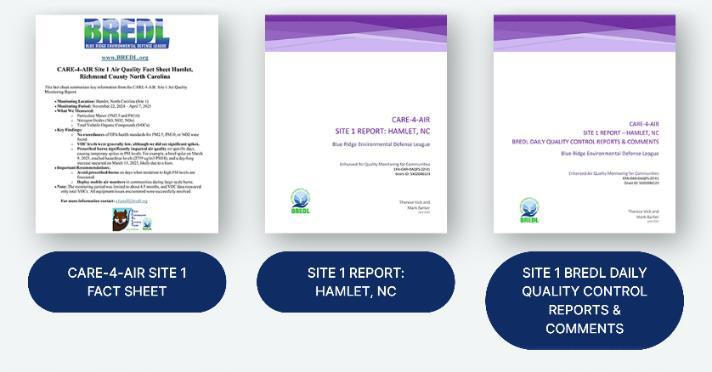
Links to site reports can be found here.
The BEAST has been moved to Site 2 where it is currently monitoring the air. The Care4Air project was made possible through a grant from the Environmental Protection Agency.
BEAST video footage for media use can be found here. BEAST photos available upon request.


A newly formed group of community members and nonprofits is seeking to help Person County, NC create a more vibrant and resilient economy. The group originally formed after Person County resident Michael Savino spoke out at a public hearing on the rezoning for the proposed Moriah Energy Center. Savino identified the need for local residents to develop their own plan for economic development that serves residents and uplifts community strengths without jeopardizing health, safety, or the rural character of the area.

The group defines economic resiliency as a community’s ability to cultivate good jobs, quality of life, and essential services, despite changing conditions, as well as to adapt to stressors and leverage new opportunities. In December, the group which includes community members, Blue Ridge Environmental Defense League, Appalachian Voices, North Carolina Black Alliance, and Down Home North Carolina, held a listening session to learn more about how Person County residents felt about the county’s economy. At that time citizens expressed frustrations about past local economic development efforts, particularly those that may have harmed the environment or neglected marginalized populations.
On February 4th the group, now known as the Partnership for a Strong Rural Economy (PSRE), held a community listening session to hear what ideas residents have for solutions. Common themes of the meeting included bolstering the agricultural economy in the county, supporting small businesses, expanding recreation opportunities, and training community youth for their future endeavors.
Savino, who also serves as one of the local organizers, said that he felt the session was productive. “What I saw there was a passionate group of people from many backgrounds and from many parts of the county coming together because they care so much about the county, and especially about our youth, wanting our young people to thrive right here in Person County.”
“I see how important it is for us to come together to share our passions, our dreams, our ideas. We need each other. Together, we can create a vibrant, healthy, thriving community, and enjoy the rich friendships that develop as we work together,” said Savino.
The group plans to hold more of these sessions throughout the year. Residents will have opportunities to learn about what other communities are doing and to take site visits to other successful projects. Brayndon Stafford, of North Carolina Black Alliance is hopeful that the meetings will leave the community more informed and feeling empowered.
“We are at a pivotal time in history where it’s more important than ever for communities to have a direct hand in the shaping of its future. Fortunately, oftentimes the work of a few can garner the impact of many. PSRE has intentionally worked to provide insight and education to Person County residents in order to engage in positive community development. This group took the initiative to engage the community with informative sessions to help residents, in the light of the challenges they may face, to understand their power and agency in shaping what a future Roxboro would look like for them.”
If your or your organization is interested in participating in these ongoing discussions, please contact Jason Torian at (336) 439-5660.
